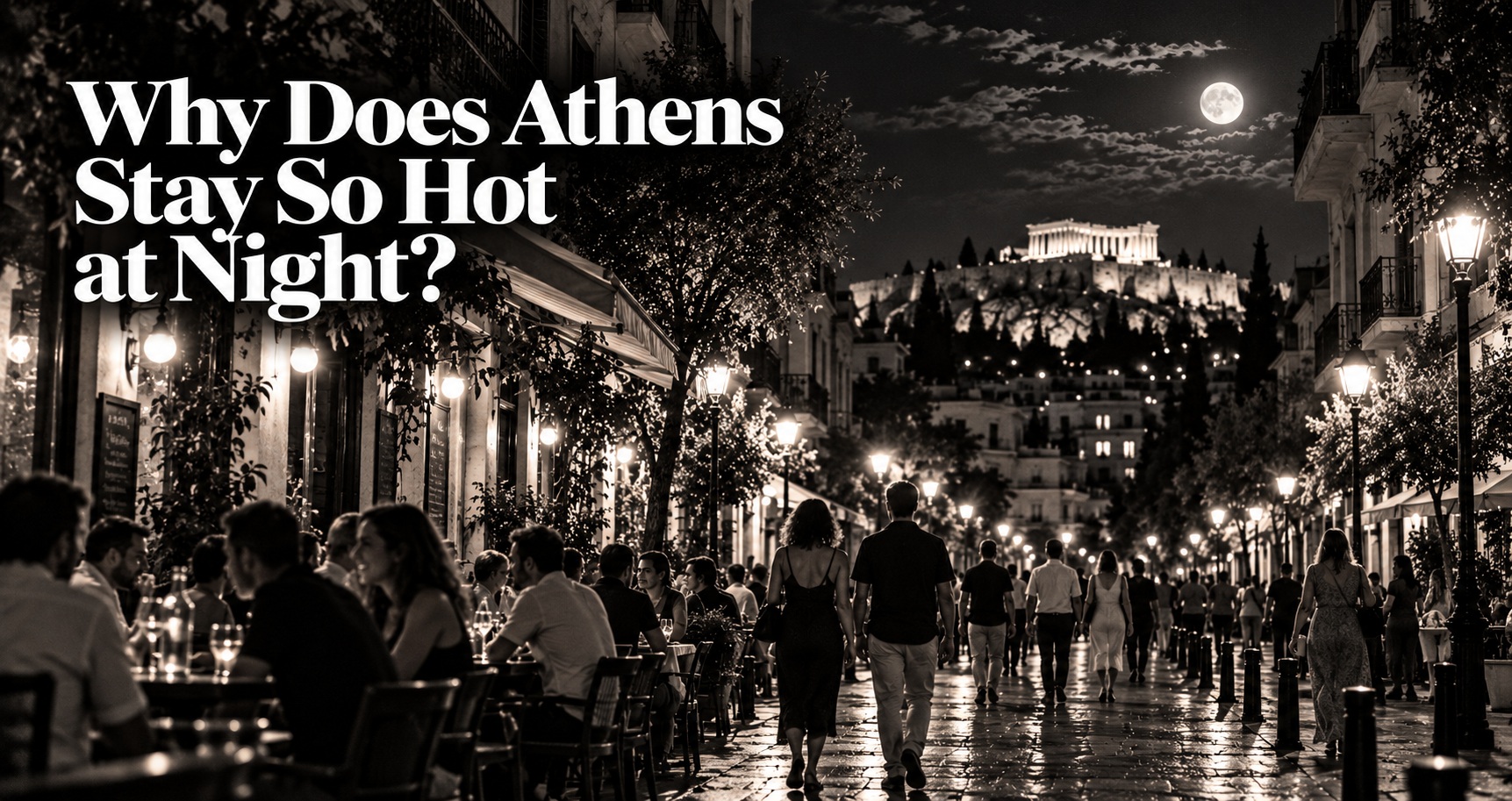

On summer nights central Athens can be 5 °C warmer than the countryside, and during heat waves the difference grows. This article explains what the measurements show, why it happens and what can reduce it.
The short answer
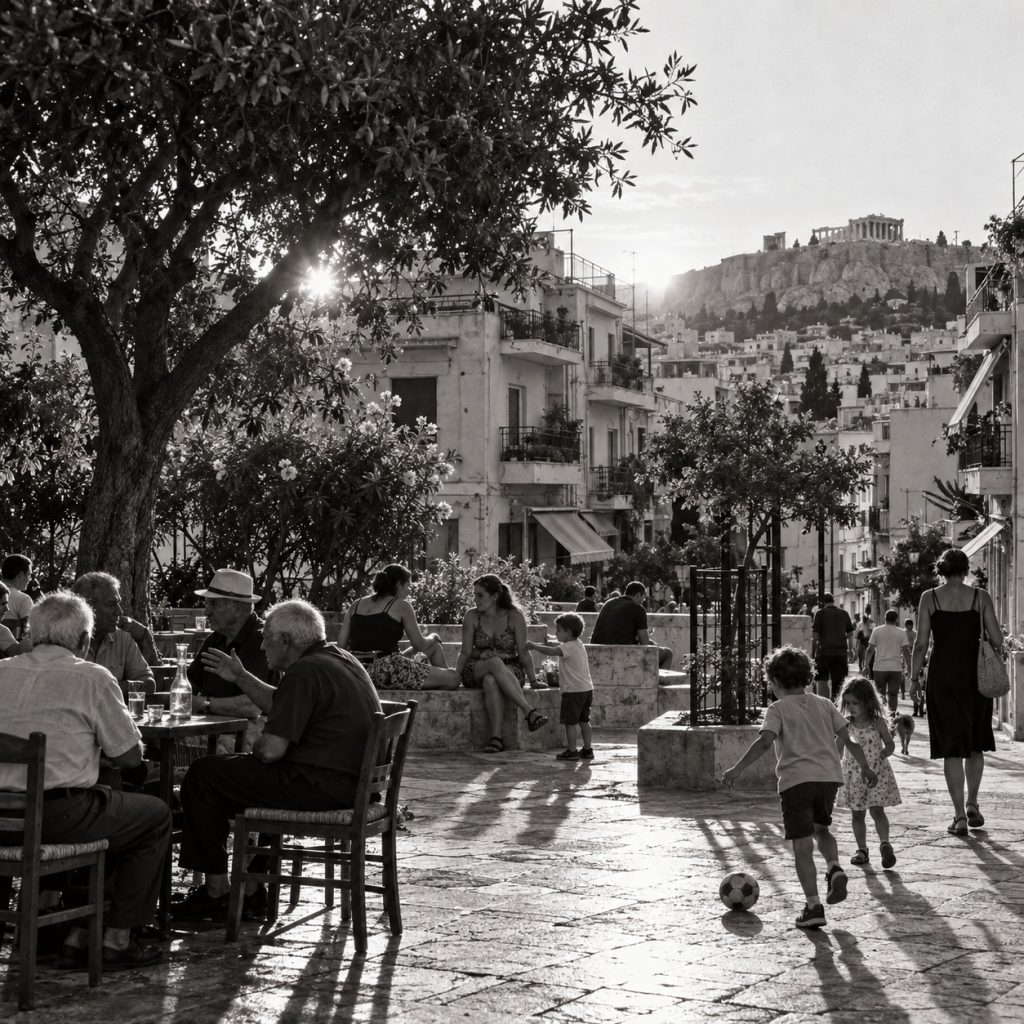 Central Athens stays warmer than its surroundings after sunset because its buildings, roads and pavements absorb solar energy during the day and release it at night, while narrow streets, weak air movement, few trees and waste heat from traffic and air conditioning slow the cooling.
Measurements by the National Observatory of Athens show that on summer nights the city centre is on average 4 °C to 5 °C warmer than a rural station north of the city.
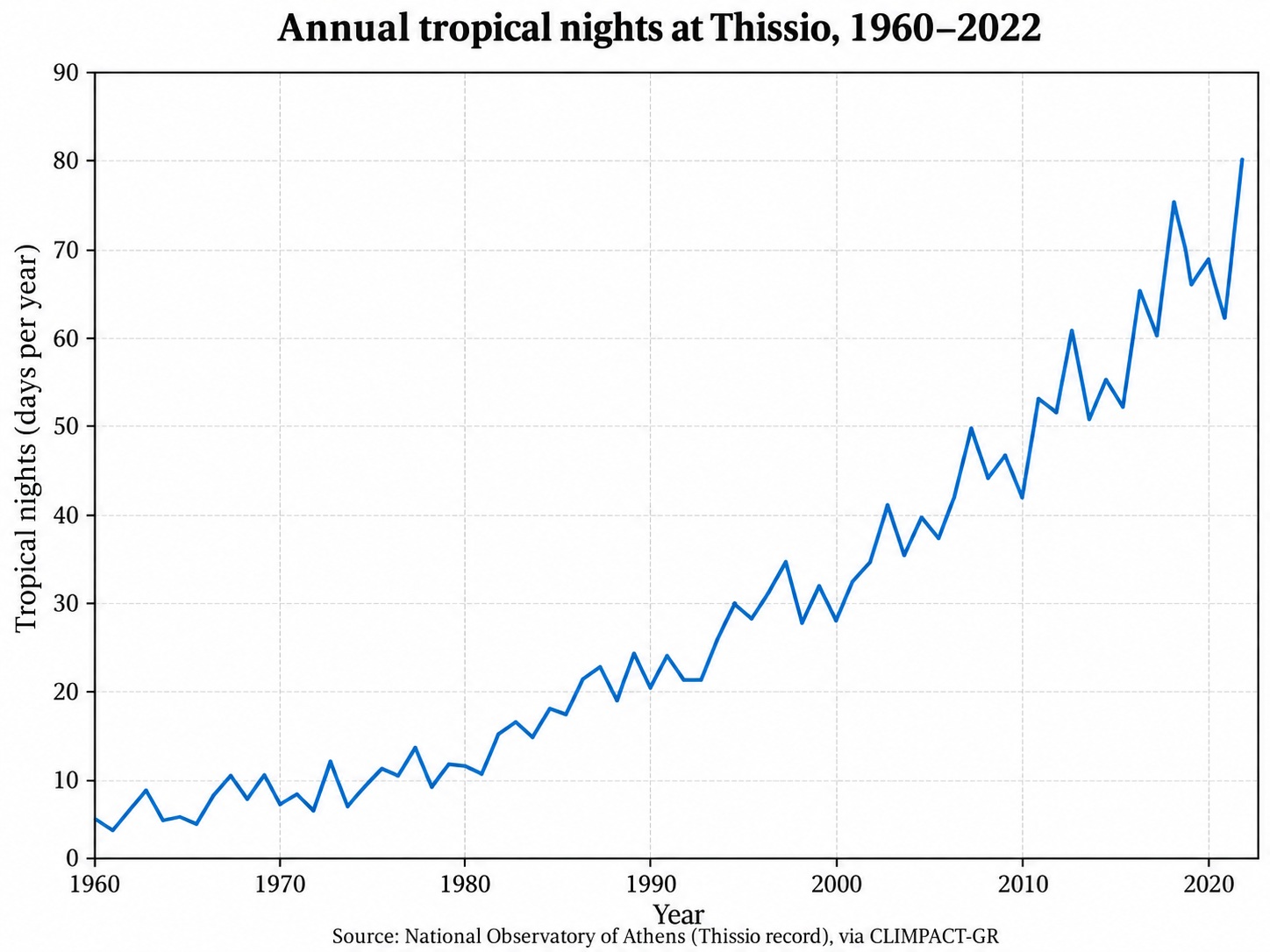
During heat waves the difference rises to 7 °C to 9 °C. The number of nights that stay above 20 °C has increased by about 6 per decade since 1960.
What the evidence shows
The longest record comes from the National Observatory of Athens station at Thissio, on a small hill near the centre, which has operated at the same site since the late 19th century. Researchers measure the city’s night-time heat by comparing its daily minimum temperature with that of a rural station at Tanagra, north of Athens. The difference between the 2 minimum temperatures is called the nocturnal urban heat island intensity. An urban heat island is a built-up area that stays warmer than the surrounding countryside, particularly after sunset.
A study by Founda and colleagues, published in Atmospheric Research in 2015, used urban and rural stations for 1970 to 2004. It found that the difference in annual mean temperature between them increased by 0.2 °C per decade, and that the heat island accounted for almost half of the warming measured in Athens over that period. Night-time and daytime heat islands behaved differently, and heat waves increased the night-time difference.
A later study by the same research group, published in Sustainability in 2022, gives numbers for summer nights. From 1970 to 2004 the summer nocturnal difference between Thissio and Tanagra was 4 °C to 5 °C. In summer 2021 it averaged 4.9 °C on days without a heat wave and 7.7 °C during that summer’s heat wave, with peaks of 9 °C. A study of summer 2012, published in Scientific Reports in 2017, found the same pattern: heat waves increased the average heat island intensity by up to 3.5 °C compared with normal summer conditions.
The number of hot nights is also increasing. A tropical night is a night on which the temperature does not fall below 20 °C. A study of large cities in the eastern Mediterranean for 1960 to 2022, published in Natural Hazards in 2026, found that Athens and Thessaloniki had the largest increase, about 6 additional tropical nights per decade, and that the increase was larger in more urbanised cities. Athens recorded 5,950 tropical nights over the 63 years of the record, an average of 94 per year.
Why this happens
The mechanism is well documented. During a summer day, concrete, stone, asphalt and roof surfaces absorb a large share of solar radiation and store it as heat. After sunset these materials release the stored heat into the air. A field of dry grass or soil stores less heat and cools faster.
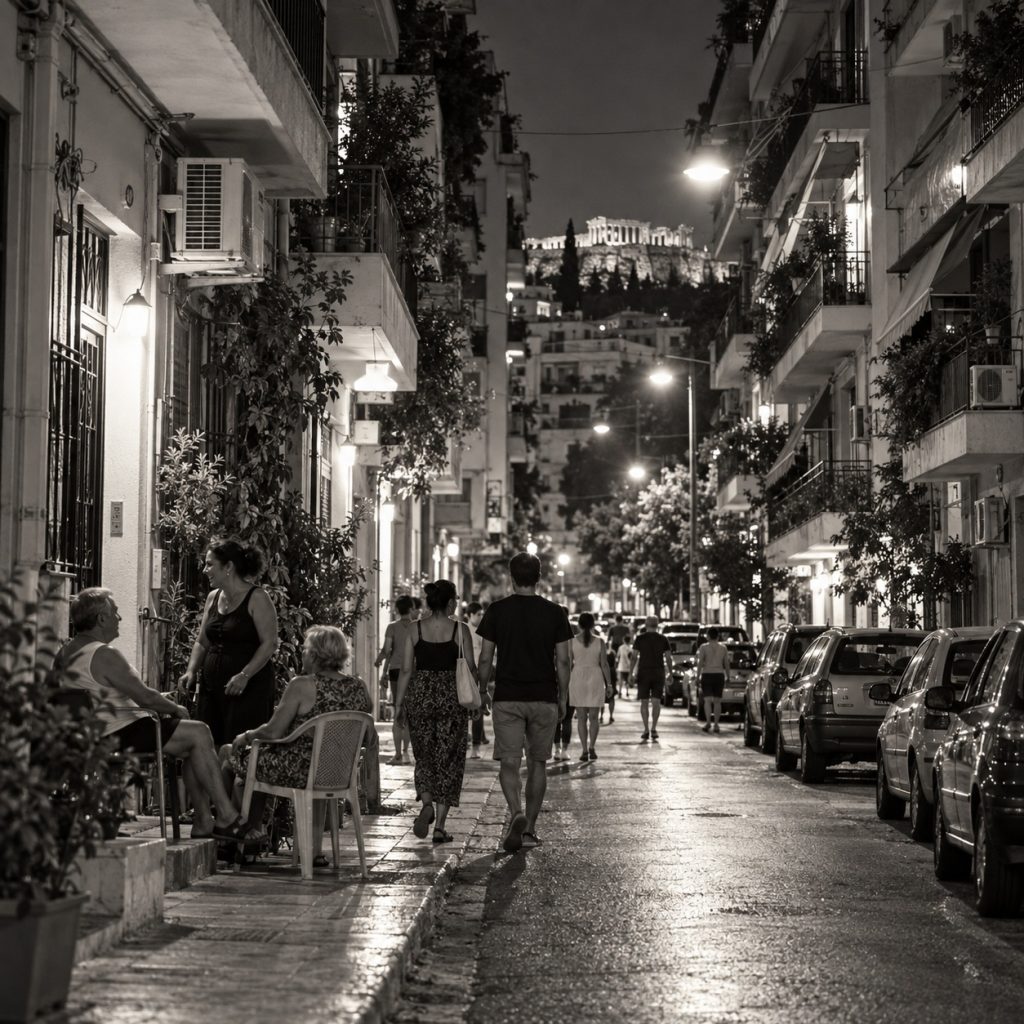 Street geometry slows the release of heat to the sky. At night a surface cools mainly by emitting infrared radiation upwards. In a narrow street between tall buildings, much of that radiation reaches the facade opposite instead of the open sky, and part of it returns to the street. Planners describe this with the sky view factor, the share of the sky visible from a point on the ground. A lower sky view factor means slower cooling.
3 further factors add to the effect. Dense building rows reduce wind speed, so less warm air is replaced by cooler air. Few trees and little exposed soil mean less evaporation, which is one of the main ways a surface loses heat. Traffic, air conditioners and other equipment add waste heat directly to the street. A 2012 study of Athens by Santamouris and colleagues lists these same causes: waste heat from human activity, reduced air flow, absence of surfaces that absorb heat through evaporation, and absorption of solar radiation by the city’s structures.
Athens adds 2 local conditions. The basin is surrounded by mountains, which, according to a climate information sheet of the University of East Anglia’s CIRCE project, favours the accumulation of air pollution under high pressure. The same conditions of high pressure and weak wind accompany heat waves, which explains why the night-time difference grows during them. The heat is also not uniform across the city. A 2011 study of the summer heat island by Giannopoulou and colleagues found the highest air temperatures in the industrial western areas and the centre and the lowest in the northern and eastern areas, with an intensity close to 5 °C.
What this means in practice
For residents, a warmer night means less cooling of homes and bodies before the next hot day. A study presented by Founda and Katavoutas at the COMECAP 2025 conference, as reported by the newspaper To Vima in June 2026, used a thermal comfort index for Athens from 1960 to 2024. In the 1960s a summer could have up to 65 nights without thermal stress. Since 2020 some summers have had as few as 15.
For households and the electricity system, warmer nights mean more hours of air conditioning. Air conditioners release the heat they remove from rooms into the street, so their use adds to the outdoor heat that the heat island already produces. The research reviewed here does not quantify this effect for Athens.
For the municipality, the evidence shows where intervention matters most. The warmest areas are the dense centre and the western districts, and the difference from the countryside is largest during heat waves, when health risks are also highest.
What the research does not tell us
Most long-term figures come from comparing 2 stations, Thissio and Tanagra. Thissio stands on a hill near the centre, not in a narrow street. Temperatures in dense streets may differ from the station values, and the studies do not give a single figure for every neighbourhood.
The share of warming caused by the heat island, almost half, applies to the period 1970 to 2004. The studies reviewed here do not give the same calculation for recent years, when climate change has raised background temperatures faster.
The newspaper report on thermal stress nights describes a conference paper, not a peer-reviewed journal article. Its figures should be treated as preliminary.
A planning perspective
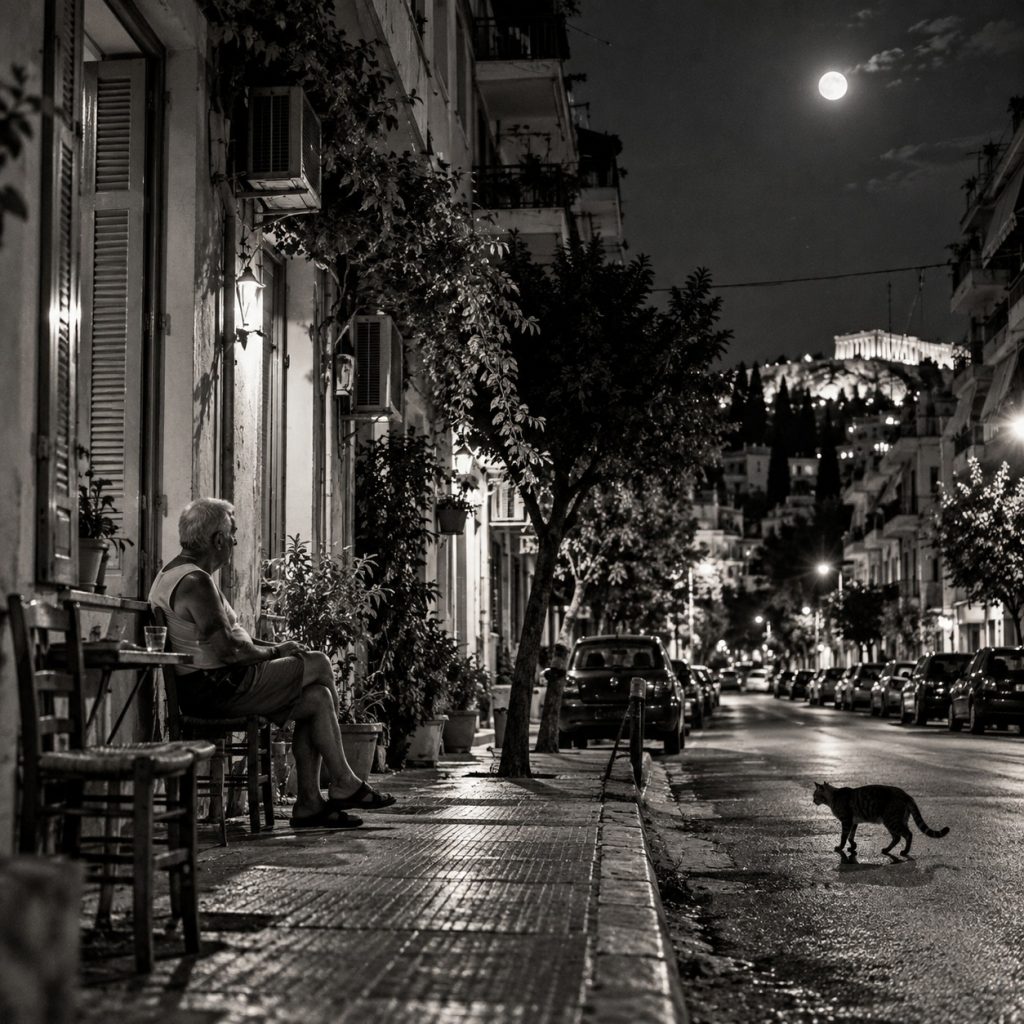 Each cause of the night-time heat requires a different type of intervention, and the evidence for each differs.
Reflective materials reduce the heat absorbed during the day. In 2012 Santamouris and colleagues reported on 4,500 m² of reflective paving installed in Flisvos Park in Palaio Faliro, in the greater Athens area. They estimated that the new surfaces reduced the peak air temperature on a typical summer day by up to 1.9 °C and the surface temperature by up to 12 °C. The study reports daytime peaks. Based on the mechanism described above, a surface that absorbs less heat during the day has less heat to release at night, but the study does not measure the night-time effect.
Trees and exposed soil add shade during the day and evaporation, which cools surfaces. Their effect depends on water availability, which is limited in Athens in summer.
Street geometry and building density are the hardest to change in an existing city. They can be addressed mainly in new development and in redevelopment, through rules on building height, street width and open space.
Waste heat from traffic and air conditioning can be reduced through public transport and more efficient cooling equipment.
The Municipality of Athens climate action plan includes reducing high temperatures and the intensity of the urban heat island among its objectives. The measurements above provide the baseline against which such measures can be assessed: the summer night-time difference of 4 °C to 5 °C between Thissio and Tanagra.
The wider picture
Night-time heat islands occur in other Mediterranean cities, but reported values differ. According to a 2026 review in Environmental Earth Sciences, studies have reported a maximum nocturnal heat island of 2.3 °C in Valencia, a summer maximum of 4.3 °C in Barcelona and a night-time value of 4.2 °C in dense areas of Bari. These figures come from different stations, periods and methods and cannot be compared directly with Athens. They show that the phenomenon is common in dense Mediterranean cities with hot, dry summers.
The takeaway
Central Athens is 4 °C to 5 °C warmer than the countryside on an average summer night and up to 9 °C warmer during heat waves, according to 5 decades of National Observatory of Athens measurements. The cause is heat stored in buildings and paving, limited cooling in narrow streets, weak air movement, few trees and waste heat. The number of nights above 20 °C is rising by about 6 per decade. What remains uncertain is the exact difference at street level in each neighbourhood and how much each intervention reduces night-time temperature. Residents can check night-time minimum temperatures for their area in the National Observatory of Athens station network at meteo.gr before choosing where to live, and the municipality can use the Thissio–Tanagra difference as the measure of whether its heat island measures are working.
Sources & further reading
- Founda, D., Pierros, F., Petrakis, M., Zerefos, C. (2015). Interdecadal variations and trends of the urban heat island in Athens (Greece) and its response to heat waves. Atmospheric Research. https://www.sciencedirect.com/science/article/abs/pii/S0169809515000988
- The extreme heat wave of summer 2021 in Athens (Greece): cumulative heat and exposure to heat stress. Sustainability, 14(13), 7766, 2022. https://www.mdpi.com/2071-1050/14/13/7766
- Founda, D., Santamouris, M. (2017). Synergies between urban heat island and heat waves in Athens (Greece), during an extremely hot summer (2012). Scientific Reports, 7, 10973. https://pubmed.ncbi.nlm.nih.gov/28887502/
- Increasing trends in the nocturnal and compound hot extremes in Eastern Mediterranean cities (1960–2022). Natural Hazards, 2026. https://link.springer.com/article/10.1007/s11069-025-07844-6
- Giannopoulou, K. et al. (2011). On the characteristics of the summer urban heat island in Athens, Greece. https://www.researchgate.net (publication 248163894)
- Santamouris, M., Gaitani, N., Spanou, A., Saliari, M., Giannopoulou, K., Vasilakopoulou, K., Kardomateas, T. (2012). Using cool paving materials to improve microclimate of urban areas: design realization and results of the Flisvos project. Building and Environment, 53, 128–136. https://coolrooftoolkit.org (Flisvos-Cool-Pavement.pdf)
- An observational analysis of the urban heat island in the eastern Mediterranean coast: the case of Thessaloniki, Greece. Environmental Earth Sciences, 2026. https://link.springer.com/article/10.1007/s12665-026-12851-2
- To Vima. Greece’s heatwaves: 5 times more frequent, 7 times longer, June 2026. https://www.tovima.com/climate/greeces-heatwaves-5-times-more-frequent-7-times-longer/
- CIRCE project, University of East Anglia. Information sheet on observed climate indicators: Athens. https://crudata.uea.ac.uk/projects/circe/Athens_climate_infosheet.doc
- CLIMPACT-GR. Thissio station datasets. https://data.climpact.gr/en/dataset?tags=Athens
- Municipality of Athens. Climate action plan. https://www.cityofathens.gr/poio-einai-to-schedio-drasis-tis-athinas/
Article information
Author: Kostas Kourounis
Topic: Heat, Water & Climate / Research Explained
Places discussed: Athens, Greece
Primary themes: urban heat island, tropical nights, heat waves, street geometry, cool materials