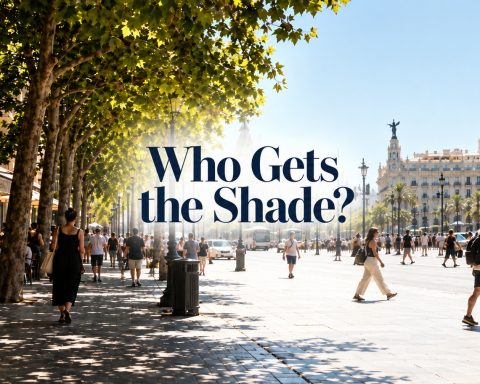

Mediterranean-climate cities plant trees, coat streets with reflective materials and open air-conditioned shelters. Measurements show that the measure that most reduces the heat pedestrians feel is shade, placed where and when they walk.
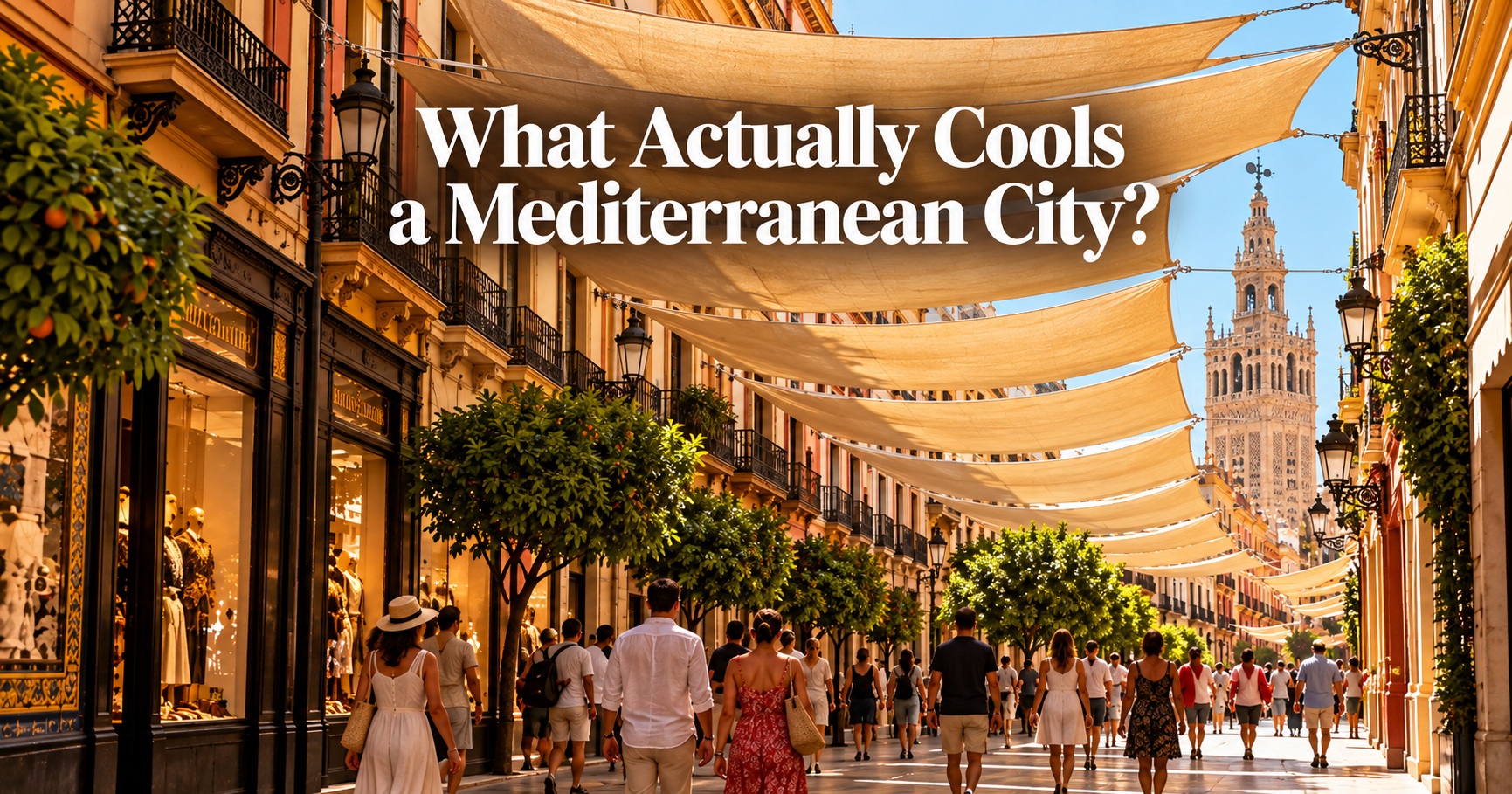
Every summer, fabric awnings are hung between the buildings of Calle Sierpes and Calle Tetuán, the main shopping streets of central Seville, at roof height. The practice is spectacular and very popular with photographers. It also demonstrates something this site is concerned with, namely that the heat a person feels in the street depends mainly on whether that person is in the shade or in the sun.
In July 2026, researchers at the University of Seville reported the same conclusion. They did not rely on the intuition of shoppers. They used satellite images, drones, street sensors and computer simulations.
Other cities chose other measures. In Los Angeles, the streets of entire neighbourhoods were covered with a light-coloured coating that reflects sunlight. Barcelona runs more than 500 climate shelters, public spaces where residents can escape the heat, while Athens, Marseille, Rome and Lisbon open air-conditioned rooms on the same principle under different legal arrangements.
The short answer
- Shade is the most effective way to reduce the heat that people feel in a Mediterranean street, according to researchers at the University of Seville.
- Reflective road coatings in Los Angeles lowered air temperature by up to 1.9°C (3.5°F), but they can send more sunlight onto a person standing on them.
- Water misters cool small spaces well in dry air and much less in humid air.
- Air-conditioned shelters protect the people inside, but their outdoor units release more heat into the street than they remove from the rooms.
- Which measure works depends on the place, the climate and the time of day, and it can only be judged by measurements taken at pedestrian height.
Why a thermometer does not describe the heat a person feels
At an air temperature of 36°C (97°F), a pedestrian in the shade feels much less heat than a pedestrian on asphalt between buildings that have been absorbing sunlight all day. The human body is heated by the air, but also by direct sunlight and by the heat radiated from walls and the ground. Researchers call the total heat load on the body heat stress. The temperature shown by a weather app is air temperature only, and it does not describe what reaches a person’s skin.
Measuring this difference, and finding which measures reduce it, is the aim of Sustainable Cooling in Cities, an international research programme run under the International Energy Agency (IEA) from 2025 to 2029. The programme examines which measures cool people, by how much and under which conditions. The findings below were presented in its seminars in summer 2026 or come from published studies listed at the end of this article.
Seville: shade reduces pedestrian heat stress more than greenery
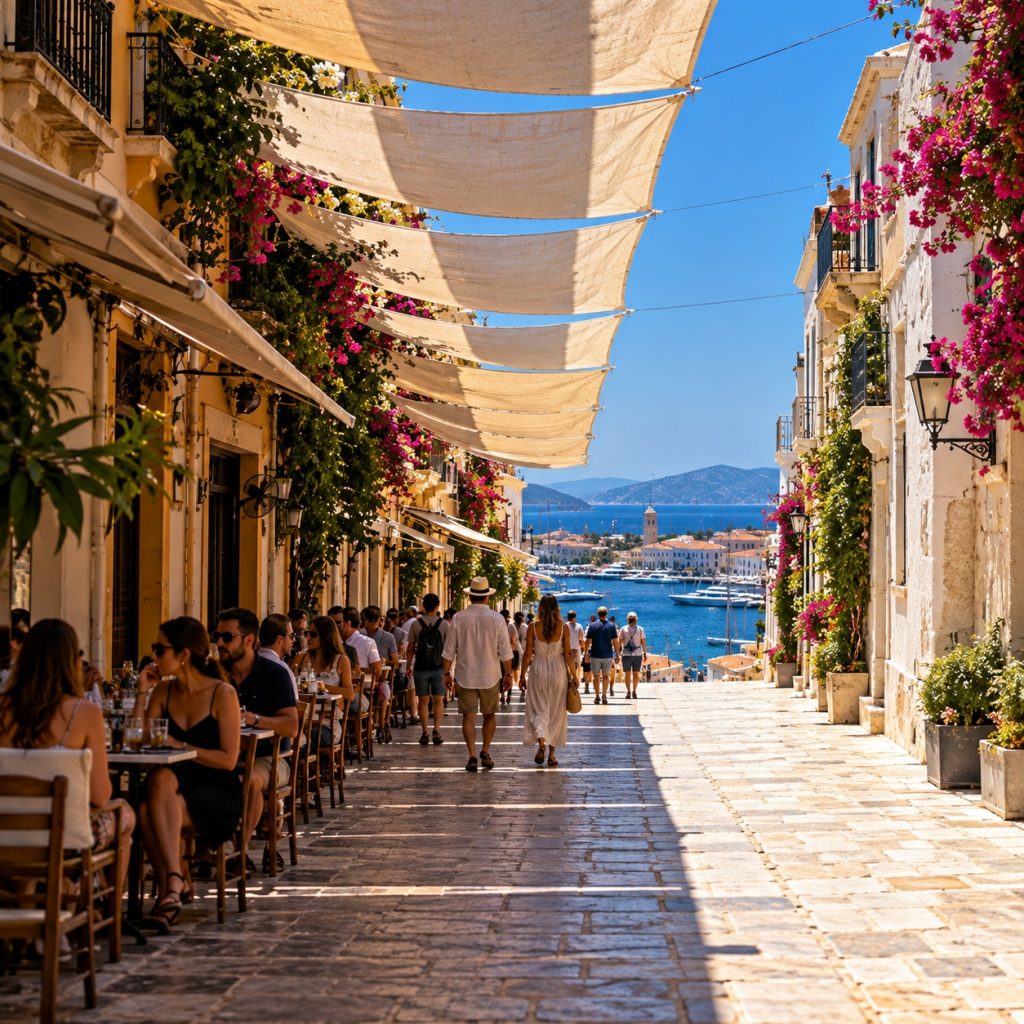
The University of Seville team compared shade, planting and light-coloured paving at several scales, from the whole city and its neighbourhoods down to squares and building courtyards.
According to Victoria López Cabeza, who presented the results in a programme seminar on 22 July 2026, shade ranked first for reducing pedestrian heat stress.
Planting and light-coloured paving also helped, but less. The published summary of the presentation gives no figures, so the size of the difference is not yet known.
Los Angeles: the road cooled, the pedestrian less so
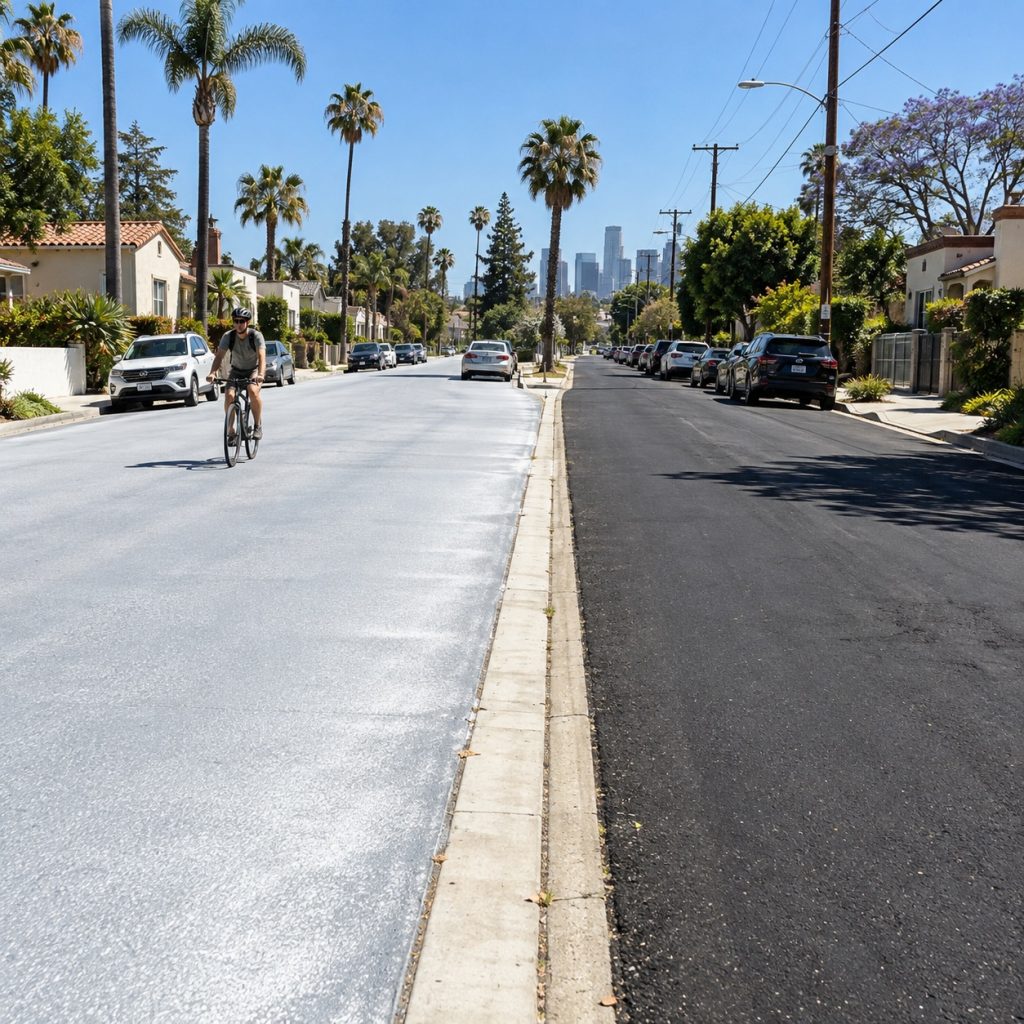
A light-coloured road surface absorbs less sunlight than black asphalt and therefore heats up less. The sunlight it reflects does not disappear. Part of it escapes to the sky and part of it reaches the surrounding walls and the people standing on the road. In 2019, a research team that included Ariane Middel measured in Los Angeles that a person standing on a reflective coating received noticeably more sunlight than a person standing on ordinary asphalt.
In 2022, the company GAF, which sells reflective coatings, covered the streets of 18 urban blocks in Pacoima, a neighbourhood in the San Fernando Valley and one of the hottest parts of Los Angeles. A year-long study published in 2024 found that on heatwave days the air above the coated streets was up to 1.9°C (3.5°F) cooler than in a similar neighbouring area without the coating. The reduction in the heat felt by the body averaged about 1°C (1.8°F). The project was carried out by a company with a commercial interest in the result.
The two results are consistent. A reflective road cools the road surface and slightly cools the air, but whether it cools a pedestrian depends on where that pedestrian stands. This agrees with the Seville ranking, in which light-coloured paving came after shade.
Water misters: strong cooling in dry air, weak cooling in humid air
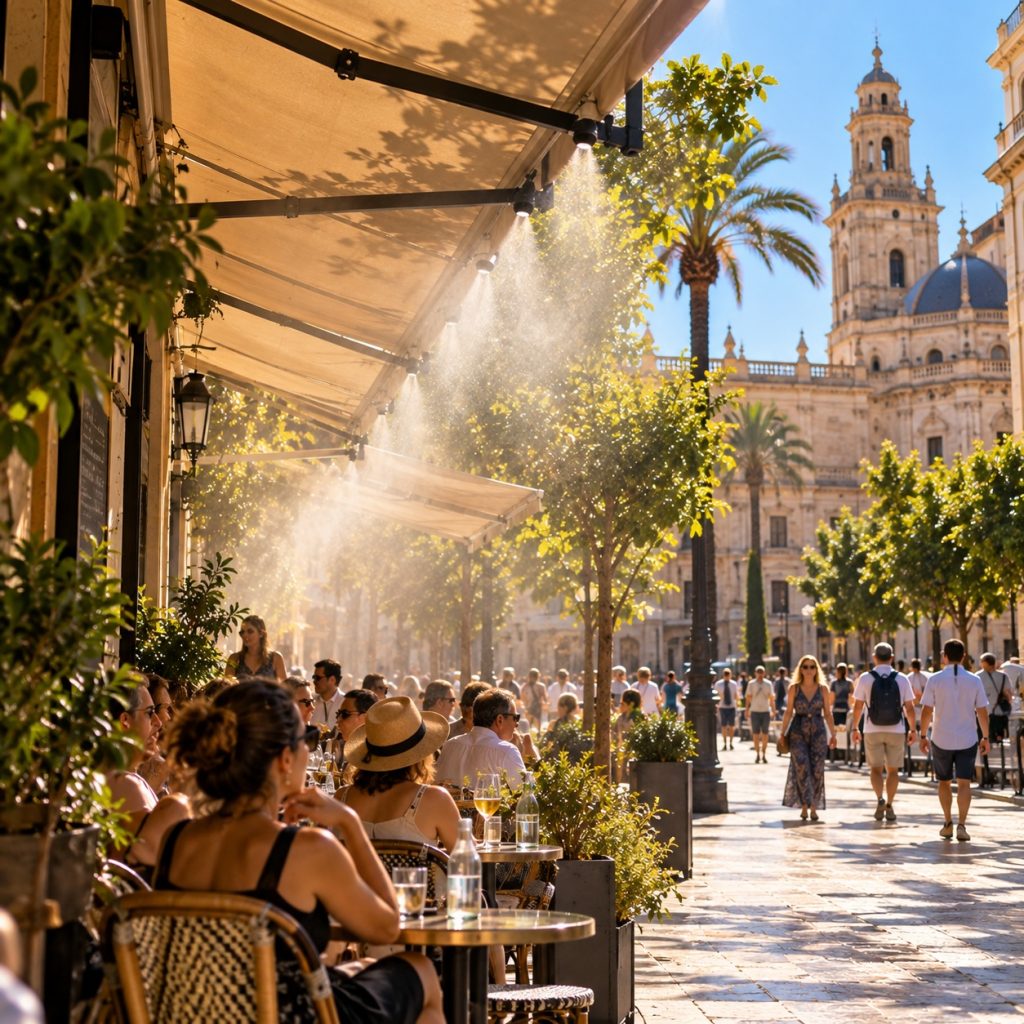
Water misters, common outside cafés and at stations, spray a cloud of fine droplets, often with a fan. The droplets evaporate and take heat from the surrounding air. A 2019 review of twenty years of studies from 12 countries found that misters can cool the air strongly, with the largest temperature drop recorded in each study averaging 8°C (14°F). This is the best result of each test, measured close to the sprayer, not the usual result.
Climate decides much of the result, because dry air absorbs water vapour easily and humid air does not. Reductions of up to 16°C (29°F) have been measured in dry Abu Dhabi and of 1.5–2.5°C (2.7–4.5°F) in humid Tokyo. Neither city has a Mediterranean climate, but together they show the two ends of the humidity range. At semi-open bus stops with little wind, another study measured about 1°C (1.8°F). Misters also use water and electricity, and their water must be checked for hygiene because it lands on people.
Climate shelters from Barcelona to Athens
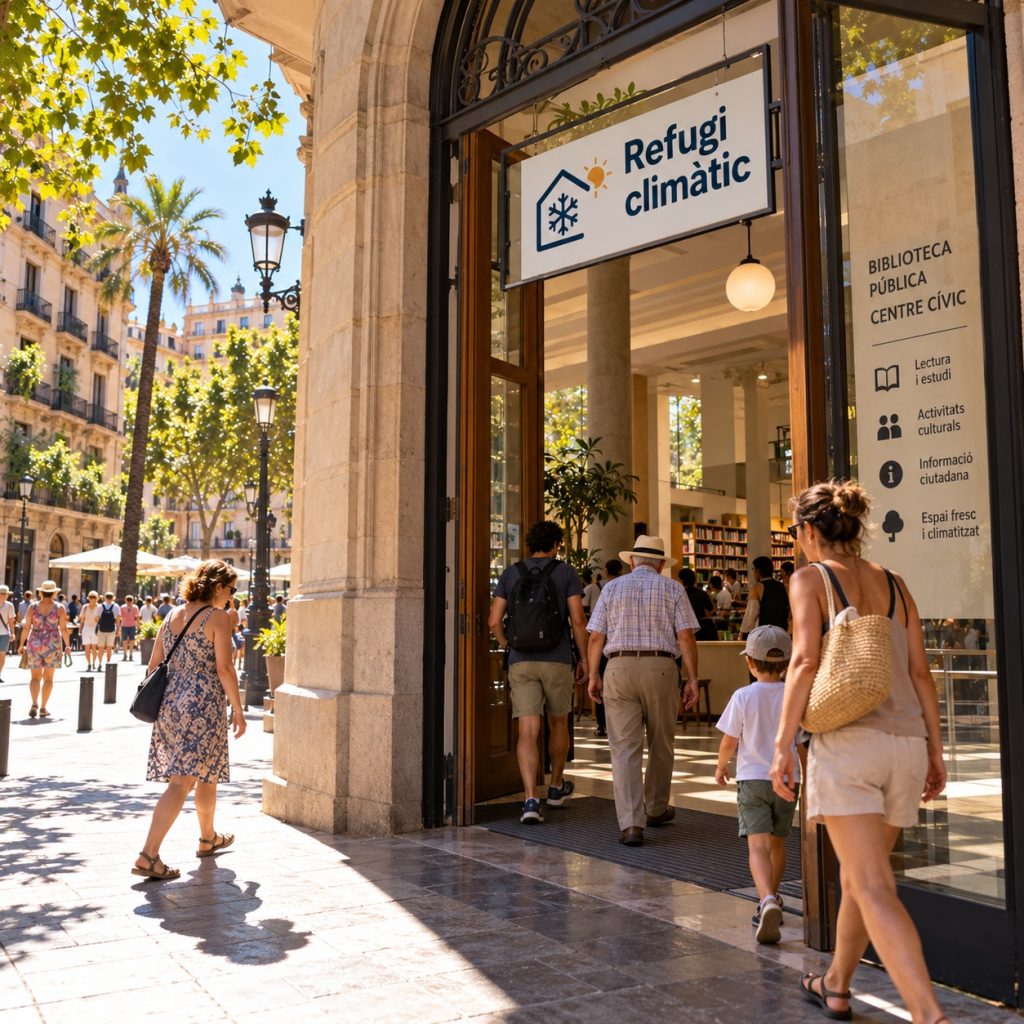
Barcelona started its network of climate shelters in 2020 with 70 spaces, and in summer 2026 it reached 500. According to the city council, 99% of residents live within a 10-minute walk of a shelter. Most shelters are indoor spaces, such as libraries, civic halls and neighbourhood centres, kept at 26°C (79°F). The council itself notes that outdoor shaded shelters may not be cool enough during heatwaves.
The measure is similar across the region, but the decision is taken at different levels of government. In Barcelona and Marseille the city council runs the network. In Rome, a mayoral ordinance allows air-conditioned municipal buildings to be opened to the public on days when Italy’s Ministry of Health declares its highest heat-risk level. In Greece, an annual circular of the Ministry of Health, an administrative instruction rather than a law, asks every municipality to open air-conditioned rooms. In Portugal, the government asks municipalities to identify such spaces, and when Lisbon announced on 1 July 2026 that two sports halls were ready, journalists who visited them the next day found that neither was yet available.
Why air-conditioned shelters also heat the street
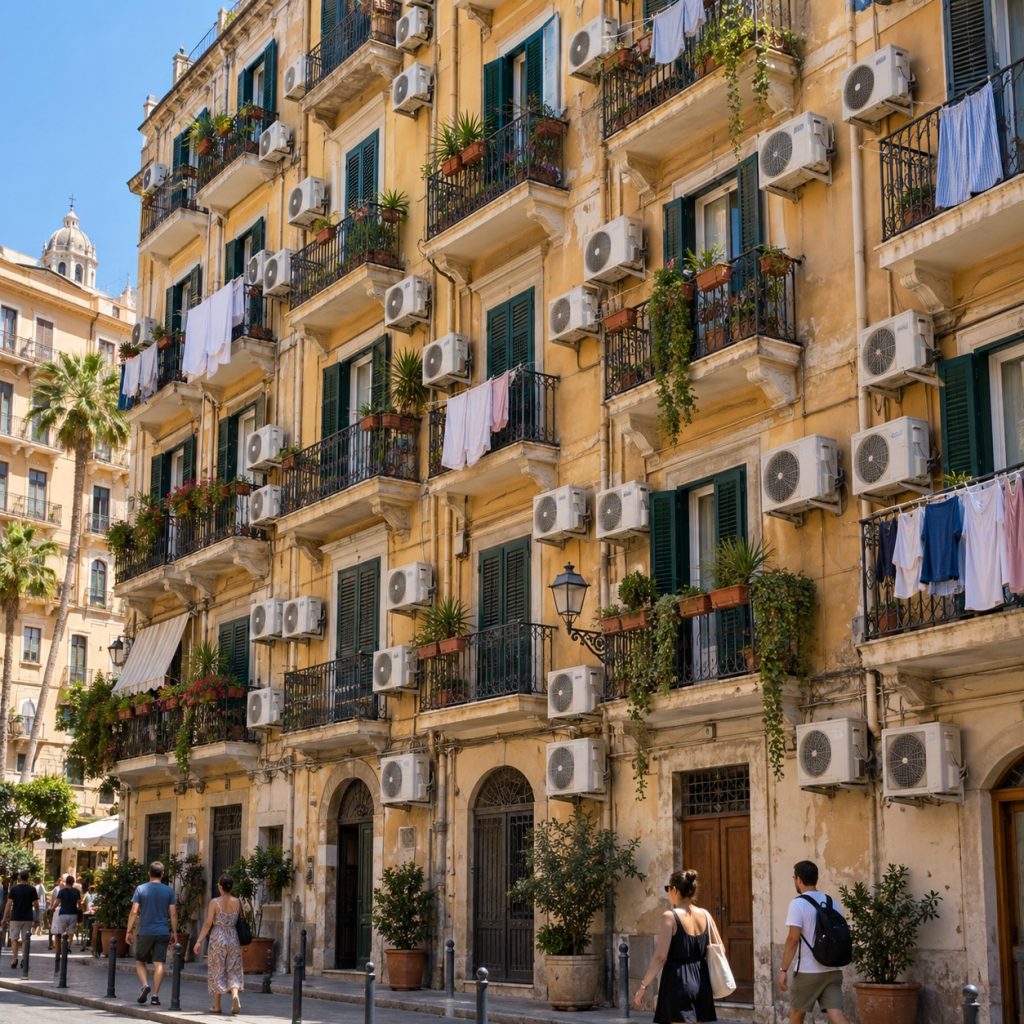
The shelters protect the people who sit inside them. The heat removed from a library does not disappear, however. An air conditioner moves it outdoors, together with the heat produced from the electricity it consumes. A worked example with assumed values:
→ An air conditioner removes 3 kWh of heat from a room.
→ To do this it consumes 1 kWh of electricity.
→ Its outdoor unit releases 3 + 1 = 4 kWh of heat into the street, courtyard or roof, which is 33% more than was removed from the room (4 / 3 = 1.33).
This is not an argument for closing the shelters, which protect vulnerable people. It is an argument for assessing the cooling of buildings together with the heat released into the street.
Marseille shows one alternative. Two district networks, Massileo and Thassalia, cool buildings in whole districts with seawater, so the removed heat goes into the sea instead of the street air.
What the research does not tell us
The Seville result comes from the summary of a seminar presentation and gives no figures, so the size of the advantage of shade over planting is not yet known. The Pacoima study concerns a project by a coating manufacturer, and a comparison between two neighbourhoods can also reflect other differences between them, such as building density or tree cover, although the researchers compared both areas before and after the coating to reduce this effect. The 2019 measurements of reflected sunlight are known here from a later paper that summarises them. For misting, the 8°C figure is an average of best results measured close to the sprayers. None of the cities discussed has published measurements of how much its climate shelters change the heat in the surrounding streets.
A planning perspective
From a planning perspective, the Seville ranking means that the area of green space in a district does not show how cool that district is for a pedestrian. Before a tree-planting programme spends public money, the planning study should map where shade falls at 14:00 and which streets carry most pedestrians. Based on the Seville and Los Angeles findings, a few trees or an awning in the right position may reduce pedestrian heat stress more than a large park in an area that few people cross in their daily trips.
The Metropolitan Area of Barcelona has adopted this approach for new projects. According to Albert Gassul, its director of public space services, every new street, square or park project must include shading, planting, rainwater use and specific targets for the heat people will feel. Results of this policy have not yet been published.
Such targets require heat to be measured as people feel it. Researchers therefore measure not only air temperature but also mean radiant temperature, a quantity that expresses how much heat the body receives from the sun and from all surrounding surfaces and that is considered a reliable predictor of thermal comfort. In Los Angeles, researchers measured it with a mobile station moved along pavements from 11:00 to 21:00, at the height and on the routes of a pedestrian. The international programme is reviewing how instruments moved along routes, satellite images, fixed weather stations and wearable devices that record volunteers’ heart rate and skin temperature can be combined, and it is preparing guidance to help municipalities choose measures suited to each area’s climate and density.
Until that guidance appears, the findings in this article support three actions that a municipality with a Mediterranean climate can already take:
- Map shade on the main pedestrian streets, pavements and bus stops between 12:00 and 17:00 in July, because shade is the most effective measure for pedestrians.
- Measure air temperature and mean radiant temperature at pedestrian height before and after every project, because without the first measurement there is no comparison and without the second there is no result.
- Publish the results together with the number of trees planted.
The takeaway
The measurements from the cities discussed are consistent. Shade reduces the heat people feel more than planting or light-coloured paving, according to the Seville team. Reflective roads cooled the air by up to 1.9°C in Los Angeles, but they can increase the sunlight reaching a person standing on them. Misters cool small spaces in dry air, while air-conditioned shelters protect the people inside and release extra heat outside. What remains uncertain is the size of each effect in each Mediterranean city, because few municipalities measure heat at pedestrian height before and after their projects. A city that reports only the number of trees it has planted does not yet know whether its streets have become cooler for the people who walk in them.
Sources & further reading
- IEA EBC Annex 97. Sustainable Cooling in Cities. Home page of the international programme, with its aims, duration and coordinators. https://annex97.iea-ebc.org/
- IEA EBC Annex 97. Annex 97 Subtasks. Detailed description of the programme’s work, including the measurement methods it reviews and the guidance it is preparing for planners and municipalities. https://annex97.iea-ebc.org/subtasks
- AIVC, venticool and IEA EBC Annex 97. Sustainable Cooling in Cities: Learnings from the State-of-the-Art Report, webinar, 7 September 2026. Programme page with slides and recordings of talks on measurement methods, water misting and the cooling policies of 13 cities. https://www.inive.org/event/7-september-2026-webinar-ebc-annex-97cities-tcp-task-5-sustainable-cooling-cities-learnings
- Holzer, P. IEA EBC Annex 97 / IEA Cities Task 5: Sustainable Cooling in Cities, presentation slides. The coordinator’s slides with the programme timeline and the finding of the earlier programme that streets and buildings affect each other’s temperature. https://www.aivc.org/system/files/16_WS_Annex%2097.pdf
- López Cabeza, V. Decoding Outdoor Thermal Comfort: Multi-scale Passive Strategies Simulation for Thermal Resilient Cities, seminar, 22 July 2026. Summary and recording of the University of Seville presentation, with the finding that shade is the most effective measure for pedestrians. https://annex97.iea-ebc.org/event?EventID=9959
- Gassul, A. Sustainable Cooling in Cities Seminar Series No. 3, 24 June 2026. Summary and recording of the presentation on the design of streets, squares and parks in the Metropolitan Area of Barcelona. https://annex97.iea-ebc.org/event?EventID=9957
- Monocle. Seville holds the secrets to managing the blistering summer heat, 2025. Report on Seville’s heat measures, including the awnings over Calle Sierpes and Calle Tetuán. https://monocle.com/affairs/urbanism/seville-summer-heat-management/
- Measuring the impacts of a real-world neighborhood-scale cool pavement deployment on albedo and temperatures in Los Angeles. Environmental Research Letters, 2022. Research paper on reflective road coatings in Los Angeles that also summarises the Middel measurements of sunlight reaching pedestrians. https://iopscience.iop.org/article/10.1088/1748-9326/ac58a8
- UCLA Luskin. On-the-Ground Guidance for L.A.’s Far-Reaching Climate Strategy, 2021. University article on the 2019 mobile measurements on reflective streets and on mean radiant temperature. https://luskin.ucla.edu/news/on-the-ground-guidance-for-l-a-s-far-reaching-climate-strategy/
- Taha, H. et al. Micrometeorological effects and thermal-environmental benefits of cool pavements: findings from a detailed observational field study in Pacoima, California. Environmental Research Communications, 2024. Full research paper with a year of measurements before and after the Pacoima coating. https://iopscience.iop.org/article/10.1088/2515-7620/ad2a8e
- Climate Resolve. Cool Surfaces in Pacoima. Page of an organisation that took part in the project, with the extent of the coating and the product used. https://climateresolve.org/cool-surfaces-in-pacoima/
- Ulpiani, G. Water mist spray for outdoor cooling: A systematic review of technologies, methods and impacts. Applied Energy 254, 113647, 2019. Review of outdoor misting studies. Full access requires a subscription. https://doi.org/10.1016/j.apenergy.2019.113647
- Urban heat mitigation through misting, and its role in broader blue infrastructure portfolios. Landscape and Urban Planning, 2025. Abstract of a research paper with misting measurements in dry and humid cities. https://www.sciencedirect.com/science/article/abs/pii/S0169204624002895
- Experimental Verification of Mist Cooling Effect in Front of Air-Conditioning Condenser Unit, Open Space, and Bus Stop. Atmosphere 14(1), 177, 2023. Open-access research paper with misting measurements in a park and at bus stops. https://www.mdpi.com/2073-4433/14/1/177
- Ajuntament de Barcelona. Climate shelters network. City council page on the climate shelter network, with a list and map of the spaces. https://www.barcelona.cat/barcelona-pel-clima/en/specific-actions/climate-shelters-network
- betevé. 500 refugis climàtics a Barcelona [500 climate shelters in Barcelona], 16 June 2026. News report from Barcelona’s municipal broadcaster with the 2026 network figures. https://beteve.cat/medi-ambient/500-refugis-climatics-barcelona-estiu-2026/
- Ajuntament de Barcelona. Més refugis climàtics per protegir-se de la calor [More climate shelters for protection from the heat]. City council announcement with the operating conditions of the shelters, including the 26°C indoor temperature. https://www.barcelona.cat/infobarcelona/ca/tema/emergencia-climatica/creix-la-xarxa-de-refugis-climatics-per-protegir-se-de-la-calor-2_1523806.html
- My-OTA.gr. Εγκύκλιος Υπουργείου Υγείας: Σε επιφυλακή οι Δήμοι για τον καύσωνα [Ministry of Health circular: Municipalities on alert for the heatwave], 20 July 2026. News report on the 2026 Greek circular, with a link to its full text. https://www.myota.gr
- Ville de Marseille. Informations et dispositifs mis en place par la Ville de Marseille. Canicule [Information and measures of the City of Marseille. Heatwave], 2024. City brochure with the air-conditioned public buildings and their map. https://www.marseille.fr (brochure_canicule-2024_v-01-08.pdf)
- Selectra. Canicule : toutes les mesures de la Ville de Marseille pour affronter la chaleur [Heatwave: all the measures of the City of Marseille against the heat], 8 July 2026. Article by an energy price comparison company describing the Massileo and Thassalia seawater cooling networks. https://selectra.info/energie/actualites/marche/canicule-marseille-mesures-mairie-plan-lieux-frais
- Roma Capitale. Prevenzione incendi e ondate di calore, i dettagli dell’ordinanza [Fire prevention and heatwaves: details of the ordinance], 2026. City of Rome announcement on the mayoral ordinance and the air-conditioned spaces opened during heatwaves. https://www.comune.roma.it/web/it/notizia/prevenzione-incendi-ondate-calore-ordinanza-roma-2026.page
- Observador. Calor. Lisboa tem dois pavilhões preparados para abrigo temporário de população mais vulnerável [Heat: Lisbon has two sports halls prepared as temporary shelters for the most vulnerable], 1 July 2026. News report on the Lisbon announcement and the government’s request to municipalities. https://observador.pt/2026/07/01/calor-lisboa-tem-dois-pavilhoes-preparados-para-abrigo-temporario-de-populacao-mais-vulneravel/
- Jornal de Notícias. Câmara de Lisboa anunciou abrigos para o calor que ainda não estão prontos [Lisbon council announced heat shelters that are not yet ready], 2 July 2026. Report on the journalists’ visit to the two sports halls. https://www.jn.pt/nacional/artigo/camara-de-lisboa-anunciou-abrigos-para-o-calor-que-ainda-nao-estao-prontos/18101855
Article information
Author: Konstantinos Kourounis
Topic: Heat, Water & Climate / Cities & Streets
Places discussed: Seville, Spain; Los Angeles, United States; Barcelona, Spain; Athens, Greece; Marseille, France; Rome, Italy; Lisbon, Portugal
Primary themes: urban heat, shade, pedestrian heat stress, cool pavements, water misting, climate shelters, air conditioning