
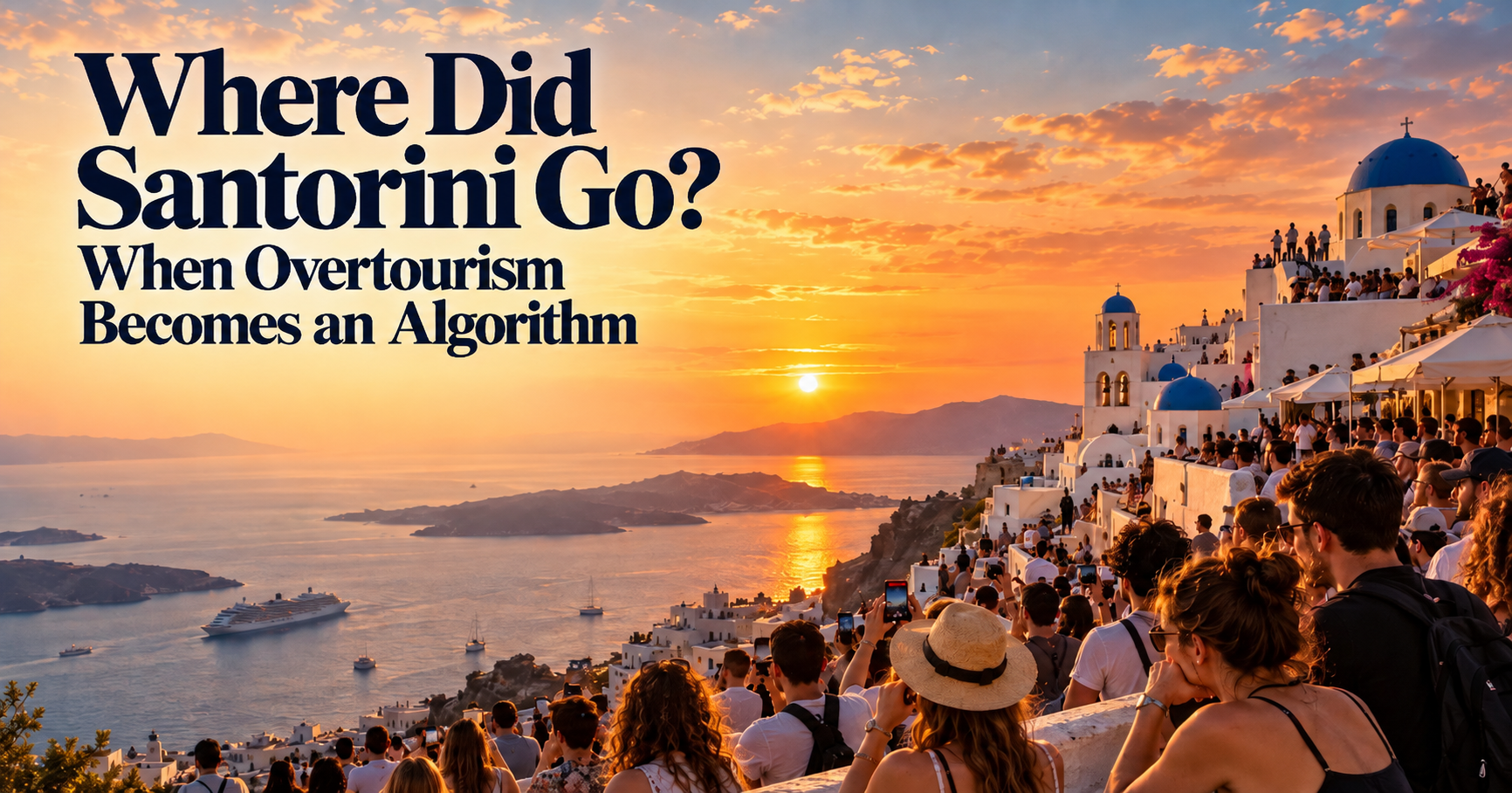

Santorini remains one of the most visited islands in Greece, yet one industry ranking of AI travel answers did not include it. This article examines what the evidence shows about crowding, reputation and AI recommendations.
Where Did Santorini Go?
The short answer
Santorini has not disappeared from global tourism. In 2025 it was the third Greek port by cruise-ship arrivals and it remains one of the best-known destinations in the Mediterranean. What has changed is one measurement of how AI systems describe it. An industry index published in April 2026 by 5W, a company that sells Generative Engine Optimisation services, found that Santorini was not among the 25 ultra-luxury destinations most often cited by AI assistants. The result is not scientific evidence and covers one market segment. It does show a mechanism that destination managers need to consider: online descriptions of crowding can influence what AI systems recommend to future visitors.
Why crowding affects Santorini more than visitor numbers suggest
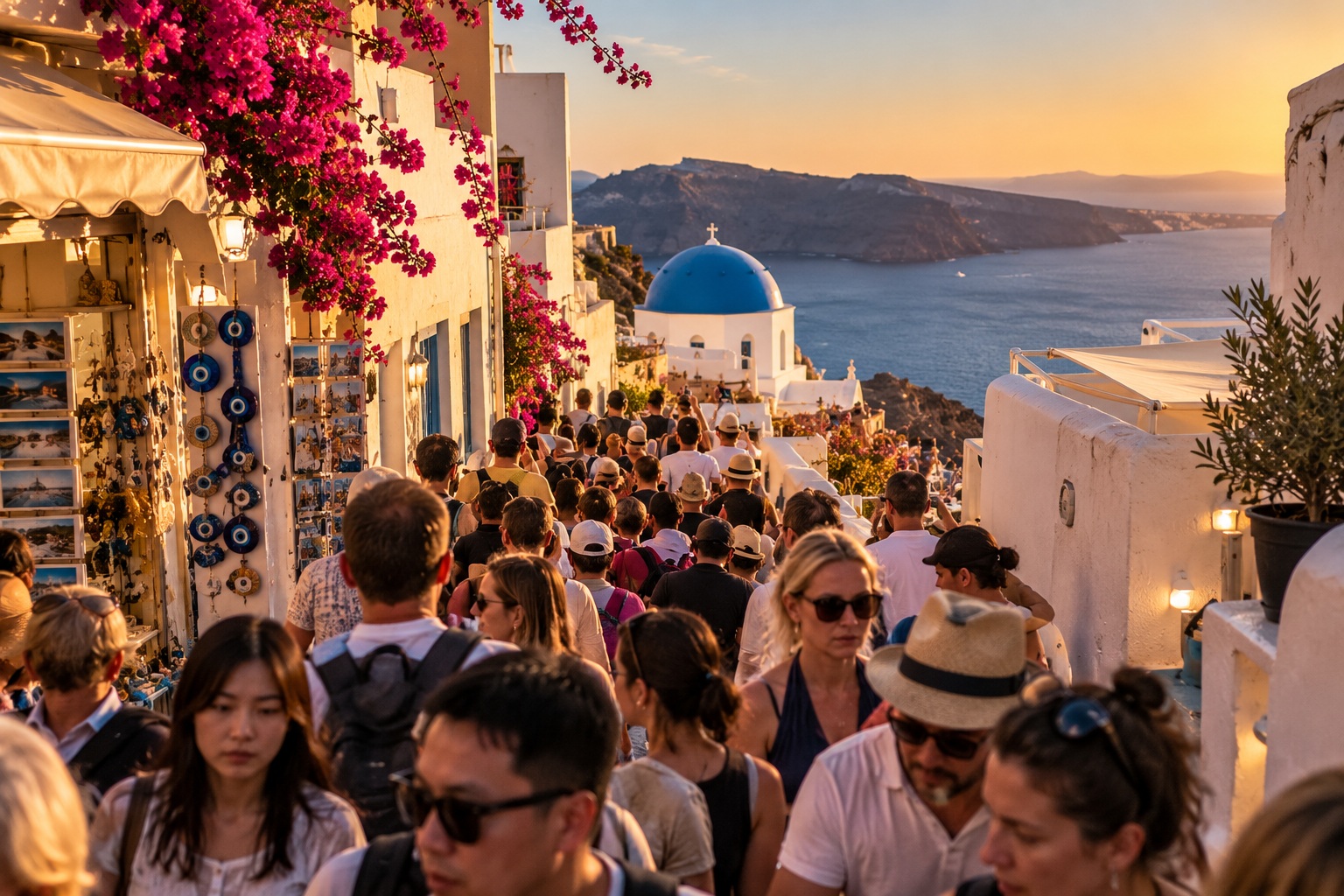
Overtourism is often discussed as a question of numbers: visitors, cruise ships and hotel beds. A number on its own does not show how much crowding reduces the value of a visit. One destination can receive large numbers of people without losing what visitors came for, while another reaches that point much earlier.
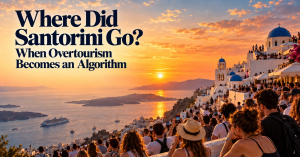
Santorini belongs to the second group. Most visitors do not go there for nightlife, shopping or large-scale entertainment. They go for the caldera, the cliff-top settlements, the views, the sunsets and the sense of open space created by the island’s topography.
Crowding reduces exactly these qualities. When hundreds of visitors stand at the same viewpoint, the sunset is physically unchanged, but the visit is no longer the one that was advertised and paid for. This difference between the physical resource and the experience sold to visitors is the basis of the rest of this article.
What the evidence shows about cruise pressure
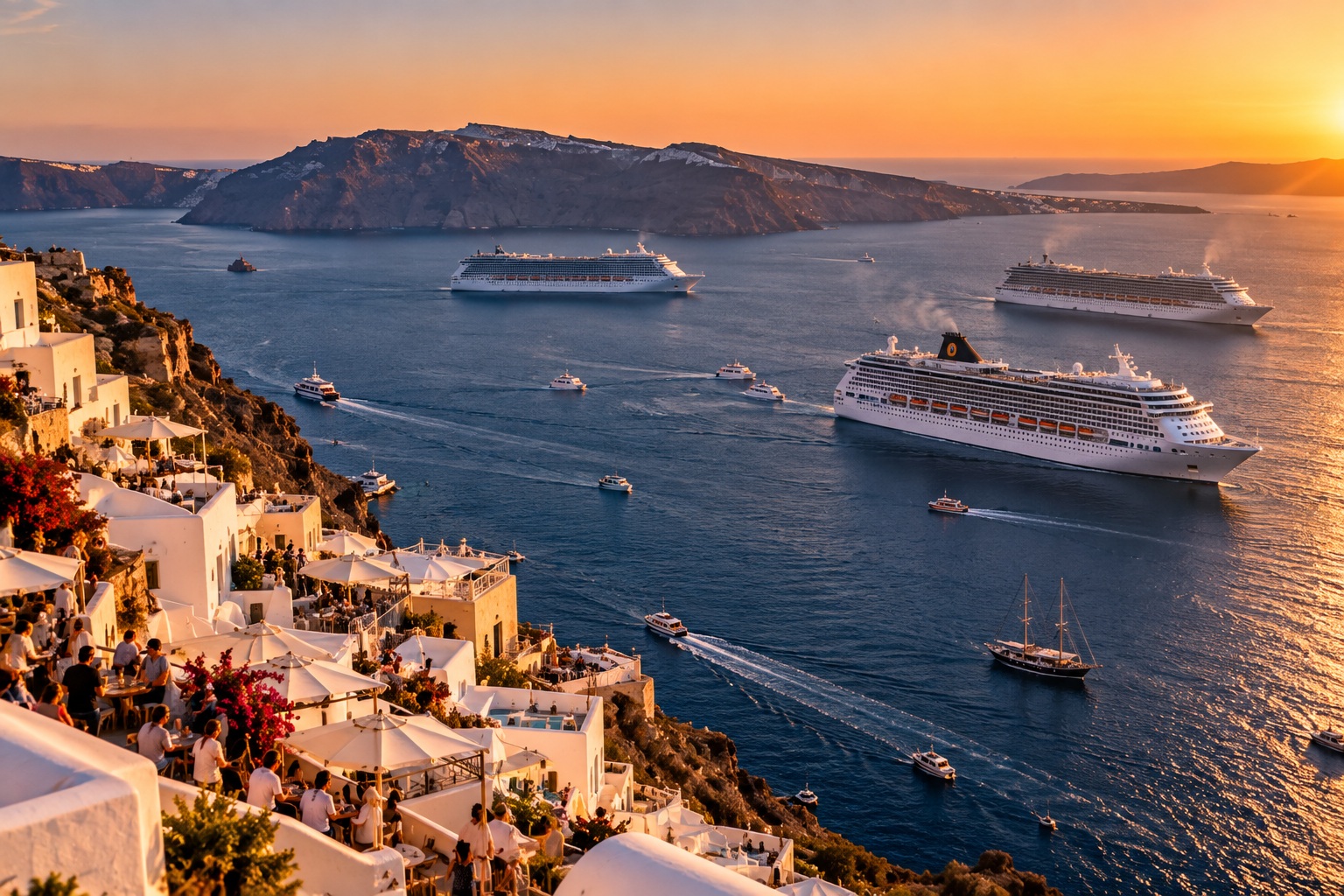
In 2025 Greece recorded 5,806 cruise-ship arrivals, according to the Bank of Greece report on the balance of travel services. Santorini accounted for 12.5% of them, behind Piraeus with 14.9% and Mykonos with 13.1%. The share corresponds to about 726 ship arrivals (5,806 × 0.125), which agrees with the 728 cruise ships recorded for Santorini by the Hellenic Ports Association.
The same Hellenic Ports Association figures, as reported by the Greek news site theopinion.gr, show 1,203,052 cruise passengers at Santorini in 2025, compared with 1,345,837 in 2024. That is a fall of 142,785 passengers, or 10.6%. Cruise pressure on the island is therefore high but did not increase in 2025.
The local port authority has already turned carrying capacity into a formal rule. Carrying capacity is the number of visitors a place can receive before its infrastructure, environment or visitor experience is damaged. Under Decision 182/2024 of 19 September 2024, the Municipal Port Fund of Thira set a maximum of 8,000 cruise passengers on the island on the same day in 2025 and in 2026. The decision states that the limit is needed to respect the destination’s capacity and to keep the port and visitor services operating in an orderly way.
The decision also changes how passengers are counted. In 2025 each ship was counted at 80% of its passenger capacity. In 2026 it is counted at 100%. For a ship with 4,000 berths, the counted number rises from 3,200 to 4,000. Two such ships on the same day counted as 6,400 passengers in 2025 and left room for 1,600 more. In 2026 the same two ships reach the 8,000 limit and no other ship can be confirmed for that day.
How AI systems now describe destinations
On 30 April 2026, 5W and Haute Black, the luxury travel arm of Haute Media Group, published the Summer 2026 Ultra-Luxury Destinations AI Visibility Index.
The index ranks 25 destinations by their share of citations in answers from ChatGPT, Claude, Perplexity and Google AI Overviews to more than 80 travel queries tracked in the first quarter of 2026. Saint-Tropez ranked first with 10.0%, the Amalfi Coast second with 8.0% and Mykonos third with 7.0%.
Santorini did not appear in the top 25. The company describes it as a “negative-citation destination” and states that coverage of overtourism and of the capacity limits led AI answers to add warnings about crowds instead of recommending specific hotels. According to this explanation, news about the cruise limit itself became part of the material that AI systems read.
This result has 2 limitations. The index is not peer-reviewed, and 5W sells services to companies that want to increase their visibility in AI answers. The full methodology, including how the 80 queries were chosen, was not reviewed for this article.
A peer-reviewed study published in Current Issues in Tourism in 2026 examined 420 travel recommendations produced by 10 widely used AI systems in response to 14 structured tourism queries. The AI systems named many destinations, but the recommendations repeatedly concentrated on a small set of iconic and semi-iconic places. The study calls this “digital overtourism”: the concentration of destination visibility at the stage before travel, when people are still choosing where to go.
The two sources reach different results. The study indicates that AI systems favour well-known places such as Santorini. The index indicates that for luxury queries Santorini is now excluded. Both results can be correct, because they measure different queries and different market segments. Taken together, they show that AI systems do not simply repeat existing demand. They select, and the selection depends on how a place is described online.
Why online reviews reach AI answers only indirectly
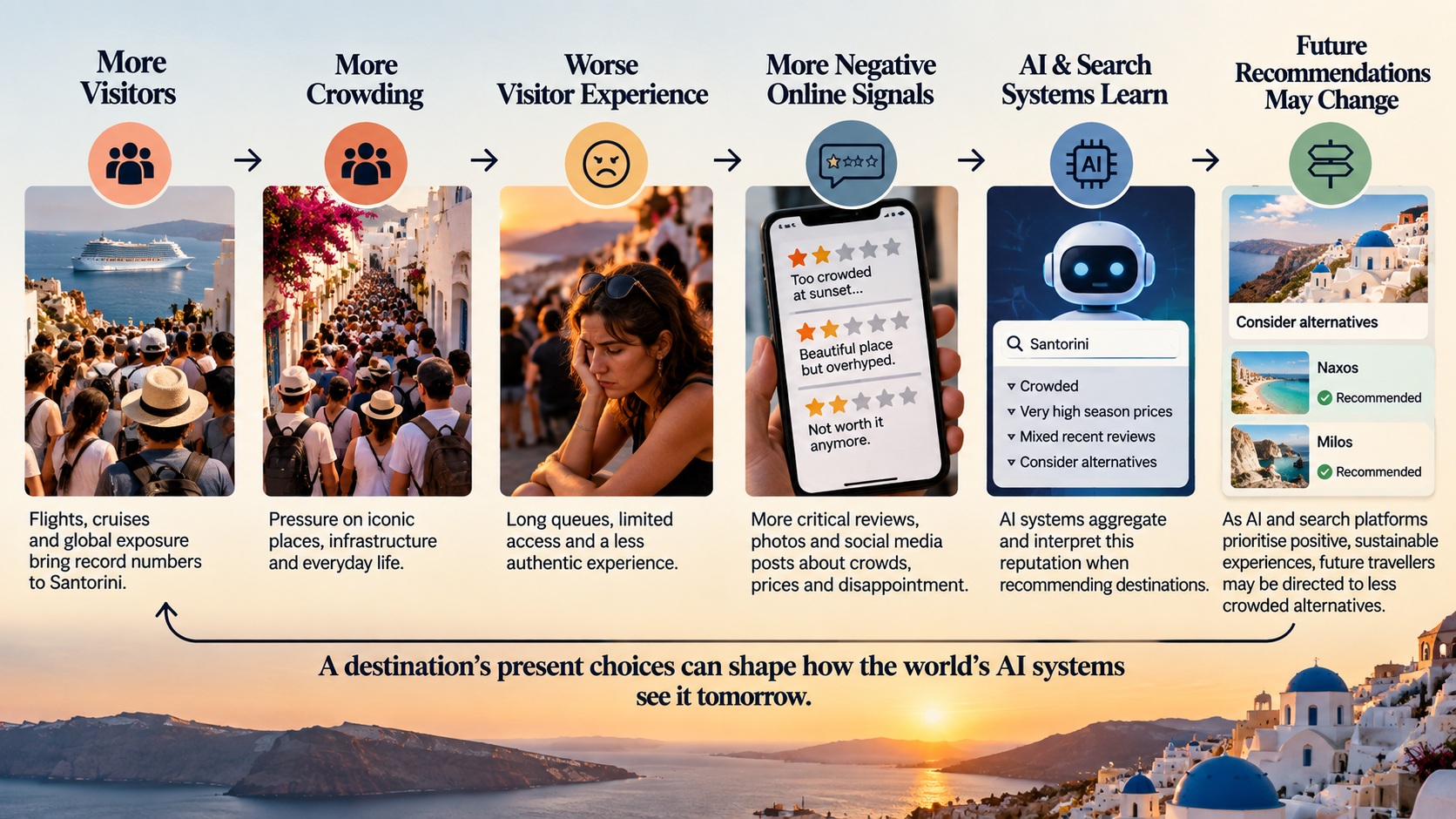
No AI system keeps a counter of complaints about Santorini. Some systems search the web at the time of the question, while others rely mainly on text included in their training data. Search results, travel articles, reviews, blogs and official reports all affect which information about a place is easy to find and summarise.
The effect is therefore indirect, but it can still change a recommendation. If many web pages associate a destination with queues, congestion, high prices and loss of local character, an AI assistant asked where to go for a quiet romantic holiday on a Greek island has less reason to name that destination first. A complaint written in August does not stop being readable in October. It remains part of the searchable description of the place.
Why Santorini and Mykonos are different
Mykonos is also crowded. It had a larger share of cruise-ship arrivals than Santorini in 2025, 13.1% against 12.5%, yet it ranked third in the same AI index. Crowding alone therefore does not explain Santorini’s absence.
From a planning perspective, the difference lies in what each island sells. For many visitors to Mykonos, crowds, nightlife, restaurants and beach clubs are part of the attraction, so high density does not contradict what they paid for. Santorini’s main attraction is open views of the caldera, and the same density reduces it directly.
There is a second explanation that must be considered. The index itself attributes part of Mykonos’s position to the Four Seasons Mykonos hotel, which it says generated about 40 trade and luxury press articles before opening. The ranking may therefore reflect new hotel publicity as well as visitor experience. Mykonos also has its own infrastructure, housing and environmental pressures, which the index does not measure.
What this means in practice
Tourism planning has usually defined carrying capacity through infrastructure and environmental limits: how many people the road network can carry, how much water is available, how much wastewater can be treated and how many passengers the port can process. These limits remain necessary and Santorini’s cruise rule is based on them.
There is another limit that is harder to measure: the number of visitors above which the visit no longer justifies its price and inconvenience for enough people. A destination can reach this limit while roads operate, hotels are full and restaurants are busy. In the past, visitors’ judgement on this point stayed in private conversations. Today much of it is written in reviews and articles that AI systems can read and summarise for the next person planning a trip.
What the research does not tell us
There is no evidence that AI systems have collectively decided to exclude Santorini. There is no single ranking produced by artificial intelligence, and different questions, models, dates, user profiles and search settings produce different recommendations. The 5W index is one method applied to one market segment.
The academic study does not examine Santorini specifically. It does not show that online complaints caused a fall in Santorini’s visibility in AI answers.
A further factor cannot be separated from crowding. In February 2025 a series of earthquakes hit the Santorini area. According to GBR Consulting figures reported by money-tourism.gr, international air arrivals at Santorini fell by 13.6% in 2025, while other major Greek island airports grew. International news coverage of the earthquakes was published a few months before the index queries were run in the first quarter of 2026. That coverage may also have affected how AI systems describe the island, and the available data do not show how much.
A planning perspective
For decades, the best-known destinations could pass much of the cost of overcrowding to visitors. The visitor waited in the queue, spent time in traffic and competed for space at the viewpoint, while the destination kept the revenue. Economists call a cost that falls on someone other than the party that causes it an external cost.
If the 5W index and the study describe a real mechanism, AI-assisted travel planning can return part of this cost to the destination. Once complaints are easy for future travellers to find, compare and summarise, overcrowding can reduce demand before visitors arrive. On that basis, a daily cruise limit protects not only residents, infrastructure and the environment but also the destination’s future demand. This conclusion depends on evidence that is still limited, and it should be tested with booking data over several seasons.
The wider picture
Historic centres, islands and coastal towns across the Mediterranean compete for visitors while trying to protect the qualities that attracted them. The sequence is well documented: more visitors bring more income and more pressure, the pressure changes the place, and the changed place provides less of what first attracted visitors. AI systems did not create this sequence.
The study in Current Issues in Tourism suggests that AI systems can make the sequence faster, because they concentrate attention on the same few places before anyone travels. Whether this effect is measurable in other Mediterranean destinations, or in other places with a Mediterranean-type climate, has not yet been studied.
The takeaway
Santorini has not been removed from AI recommendations. One commercial index found it missing from luxury recommendations in early 2026, and one peer-reviewed study shows that AI systems concentrate attention on a small number of well-known places. The evidence does not show why Santorini was not included: crowding coverage, earthquake coverage and publicity for competing destinations are all possible causes. The documented facts are narrower. The island’s daily limit of 8,000 cruise passengers controls how many people arrive, but it does not control what they write after they leave. Destination managers can act on both: enforce the arrival limit and monitor how their destination is described in reviews and AI answers each season.
Sources & further reading
- Bank of Greece. Developments in the balance of travel services: 2025. https://www.bankofgreece.gr/en/news-and-media/press-office/news-list/news?announcement=27a32287-1c58-44e7-b900-2c92c53ffe9c
- Municipal Port Fund of Thira. Cruise Arrival/Departure Evaluation for 2025 and 2026, Decision 182/2024 of 19 September 2024 (English translation). https://www.santoriniports.gov.gr/sites/default/files/2024-11/Cruise%20Ship%20Berthing%20Policy%202025-2026-Decision-FINAL-JTR-eng.pdf
- Municipal Port Fund of Thira. Cruise arrival schedules and statistics. https://www.santoriniports.gov.gr/el/cruise
- Digital overtourism in AI travel recommendations: evidence from a comparative analysis. Current Issues in Tourism, 2026. https://doi.org/10.1080/13683500.2026.2654066
- 5W and Haute Black. Summer 2026 Ultra-Luxury Destinations AI Visibility Index, press release, 30 April 2026. https://www.prnewswire.com/news-releases/5w-and-haute-black-release-summer-2026-ultra-luxury-destinations-ai-visibility-index-saint-tropez-amalfi-coast-and-mykonos-lead-1-2-trillion-luxury-travel-market-now-being-researched-on-chatgpt-claude-and-perplexity-302757709.html
- theopinion.gr. Santorini, port services and the reputation of cruising, June 2026. https://www.theopinion.gr/tourismos/santorini-kroyaziera-se-lathos-kateythynsi-leei-o-proedros-tis-clia-ti-apantaei-o-dimos-thiras/
- money-tourism.gr. What really happened to Greek Tourism in 2025: the full overview from GBR, February 2026. https://money-tourism.gr/en/what-really-happened-to-greek-tourism-in-2025-the-full-overview-from-gbr-performance-by-region/
- Dimitris Stathopoulos. The Santorini penalty: how AI is changing the map of tourism, Newmoney, September 2026. https://www.newmoney.gr/journal/
Article information
Author: Konstantinos Kourounis
Topic: Tourism & Places / Research Explained
Places discussed: Santorini, Greece; Mykonos, Greece
Primary themes: overtourism, carrying capacity, artificial intelligence, destination management, visitor experience


Find Me Elsewhere